




Natural Stone Water Absorption, Density, and Porosity: What the Numbers Really Mean
August 16, 2026 · 17 MIN READ
A technical guide for professional buyers, architects, importers, and project teams
Natural stone is often evaluated through a few numbers on a technical datasheet: water absorption, density, and porosity.
At first glance, these values can look simple.
A buyer may see:
- Water absorption: 0.25%
- Density: 2,700 kg/m³
- Open porosity: 0.8%
and immediately conclude that the stone with the lowest absorption or highest density must be the better product.
That conclusion can be wrong.
These three properties describe different aspects of the internal structure of stone, and their practical meaning depends on how the test was performed, what type of stone is being evaluated, and where the material will be used.
For professional buyers, understanding these numbers is important because they can influence decisions involving durability, moisture exposure, freeze-thaw performance, staining, maintenance, transportation, installation, and suitability for specific applications.
This guide explains what water absorption, density, and porosity actually mean, how they are related, how they differ, how to interpret laboratory results, and what buyers should ask suppliers before approving natural stone.
1. Why These Three Numbers Matter
Natural stone is not a completely solid, homogeneous material.
Even dense-looking stone contains a microscopic and sometimes visible network of:
- pores
- cavities
- microcracks
- intergranular spaces
- fractures
- mineral boundaries
The amount, size, distribution, and connectivity of these spaces influence how the stone interacts with water and other fluids.
This is why two stones that look almost identical on the surface can behave differently when exposed to moisture.
For a professional buyer, the important question is not simply:
Which stone has the lowest water absorption?
It is:
What do the measured values tell us about this particular stone, and are those properties appropriate for the intended application?
That distinction is fundamental.
2. The Three Properties Are Not the Same
Before going deeper, it is important to separate the concepts.
Water absorption
Measures how much water a stone specimen takes up under a specified test procedure, generally expressed as a percentage of its dry mass.
Density
Describes the mass contained within a given volume of the stone.
Porosity
Describes the proportion of void space within the stone.
These properties are related, but they are not interchangeable.
A stone can have:
- relatively high density but still contain interconnected pores;
- relatively low water absorption but a pore network with particular characteristics;
- high porosity but not necessarily perform poorly in every application.
The details matter.
3. What Is Water Absorption?
Water absorption indicates the amount of water that enters a stone specimen under defined laboratory conditions.
A commonly used expression is:

where:
- Mdry = mass of the dry specimen
- Mwet = mass after the specified water-conditioning procedure
The exact conditioning and measurement procedure depends on the applicable test standard.
Therefore, a reported absorption value should never be interpreted independently of the test method.
4. What Does a Low Water Absorption Value Mean?
Generally, a lower water absorption value indicates that the specimen takes up less water under the specified test conditions.
This can be desirable in applications where moisture exposure is important.
Potentially relevant applications include:
- exterior façades
- outdoor paving
- wet environments
- areas exposed to precipitation
- freeze-thaw climates
- some kitchen and commercial applications
However, it would be inaccurate to say:
Low water absorption automatically means high durability.
Durability is a broader concept.
A stone’s long-term performance can also depend on:
- pore structure
- mineral composition
- microcracking
- thermal behavior
- freeze-thaw exposure
- chemical environment
- installation system
- environmental conditions
Water absorption is therefore an important indicator, not a complete durability rating.
5. Why Water Absorption Is Particularly Important in Cold Climates
One of the most important reasons moisture matters is the possibility of freeze-thaw damage.
When water enters pores and subsequently freezes, its volume increases.
Repeated freezing and thawing can generate stresses within the stone.
Depending on the stone’s pore structure and other characteristics, repeated cycles may contribute to:
- cracking
- surface deterioration
- scaling
- loss of material
- reduction in mechanical performance
This is why a stone intended for an exterior project in a cold climate should not be approved solely because its water absorption looks acceptable.
Where freeze-thaw exposure is relevant, the stone should be evaluated against the appropriate freeze-thaw test requirements for the intended application.
6. Water Absorption Is Not the Same as Waterproofness
This distinction is often misunderstood.
Natural stone with low water absorption is not necessarily waterproof.
Water can enter through:
- open pores
- microcracks
- joints
- cut edges
- installation interfaces
- fissures
- surface imperfections
Furthermore, laboratory water absorption is measured under controlled conditions.
Real buildings experience:
- rain
- pressure differences
- temperature changes
- standing water
- capillary movement
- drainage conditions
- repeated wetting and drying
Therefore, laboratory absorption data should be interpreted as a material property—not as a guarantee that an installed stone assembly will never allow moisture movement.
7. What Is Density?
Density describes mass per unit volume.
The basic relationship is:
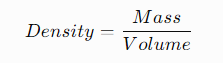
It is commonly reported in:
- kg/m³
- g/cm³
For example:
2,700 kg/m³ = 2.70 g/cm³
Density is useful because it provides information about the overall compactness and material composition of the stone.
8. Why Density Matters to Natural Stone Buyers
Density can affect several practical aspects of a project.
Transportation
A denser stone weighs more for a given volume.
This matters when calculating:
- container loading
- truck payload
- lifting requirements
- shipping costs
- handling requirements
Structural considerations
The weight of stone can be relevant to:
- façade systems
- large-format panels
- suspended applications
- structural load calculations
Product handling
Large blocks and slabs can become extremely heavy.
Understanding density allows logistics teams to estimate approximate weight before physical weighing.
9. Density Does Not Equal Strength
This is one of the most important points in the entire article.
A buyer should not assume:
Higher density = stronger stone
The relationship is not that simple.
Mechanical performance depends on factors including:
- mineral composition
- grain structure
- bonding between minerals
- microcracks
- anisotropy
- natural discontinuities
- weathering
- moisture condition
- direction of loading
A dense stone may have excellent mechanical performance, but density itself is not a substitute for strength testing.
If structural or mechanical performance matters, examine the relevant:
- compressive strength
- flexural strength
- breaking load
- abrasion resistance
rather than attempting to infer strength from density alone.
10. What Is Porosity?
Porosity describes the proportion of void space within a material.
It can be expressed as:

The key concept is that not all pores behave the same way.
This is where professional interpretation becomes important.
11. Open Porosity vs. Closed Porosity
Pores can broadly be considered according to whether they are accessible and connected to the surrounding environment.
Open porosity
These are pores that are accessible to fluids through connections to the exterior.
Open porosity is particularly relevant to:
- water movement
- moisture absorption
- staining
- freeze-thaw exposure
- treatment penetration
Closed porosity
These voids are isolated or poorly connected to the exterior.
They contribute to the internal void structure but may not participate in water absorption in the same way as interconnected open pores.
This explains why:
Total porosity and water absorption are not identical measurements.
The structure and connectivity of the pore network matter.
12. Why Pore Structure Matters More Than a Single Porosity Number
Imagine two stones with similar total porosity.
Stone A contains:
- very small, poorly connected pores.
Stone B contains:
- larger, interconnected pores.
Their behavior with water can be very different.
The second stone may allow water to move through its pore network more readily.
Therefore, when assessing moisture-related performance, a professional analysis should consider more than simply:
What is the porosity percentage?
It should also consider:
What is the nature and connectivity of that pore structure?
This becomes particularly relevant for naturally porous stones such as some varieties of travertine and limestone.
13. The Relationship Between Density and Porosity
For many mineral-based materials, density and porosity are mathematically related when the appropriate densities and volume definitions are used.
A simplified relationship can be expressed as:
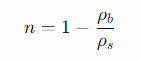
where:
- n = porosity
- ρb = bulk density
- ρs = density of the solid material
The exact calculation depends on how the densities are defined and measured.
This relationship illustrates an important principle:
Density tells you how much mass occupies a given bulk volume, while porosity tells you how much of that bulk volume is void space.
They provide different perspectives on the same internal structure.
14. Why Travertine Requires Special Attention
Travertine is an excellent example of why these parameters must be interpreted carefully.
Travertine can naturally contain:
- cavities
- channels
- interconnected voids
- variable pore structures
Different travertine deposits can therefore exhibit significantly different physical properties.
Even within commercially similar materials, properties can vary depending on:
- quarry location
- geological layer
- block selection
- filling process
- processing method
A buyer should therefore avoid assuming:
All Iranian travertine has the same water absorption or porosity.
It does not.
The relevant values should be associated with the specific commercial material being supplied.
15. Natural Stone Is Naturally Variable
Unlike engineered materials manufactured from a tightly controlled recipe, natural stone originates from geological processes.
Variation can occur between:
- different quarries
- different quarry benches
- different blocks
- different sections of a block
- different production batches
This is one reason technical documentation should be interpreted alongside quality-control procedures.
A single historical laboratory result does not automatically prove that every future block will have identical properties.
16. Does Sealing Change Water Absorption?
Surface treatments and sealers can change the behavior of a stone surface.
A sealer may reduce:
- surface penetration
- staining susceptibility
- absorption of certain substances
depending on the product and application.
But a sealer should not be treated as a way to fundamentally change the stone’s geological structure.
It does not automatically transform a highly porous stone into a dense stone.
This distinction is particularly important when discussing technical specifications.
Material property vs. treated performance
A technical datasheet may describe the untreated stone.
A project specification may instead require performance after a particular treatment.
These are different questions and should not be mixed.
17. Does Polishing Reduce Porosity?
Polishing changes the surface condition of stone, but it does not eliminate the internal pore structure of the material.
A polished surface can behave differently from a rough or textured surface in terms of:
- surface wetting
- staining
- cleaning
- appearance
- maintenance
However, polishing should not be interpreted as eliminating internal porosity.
The underlying stone remains a porous geological material.
18. Water Absorption and Staining
Higher water absorption can sometimes be associated with greater susceptibility to penetration of liquids, but this does not mean:
Higher absorption always equals higher staining.
Staining depends on multiple factors, including:
- pore structure
- liquid viscosity
- chemical composition
- exposure time
- surface finish
- treatment
- contaminant type
For example, oil-based substances can behave very differently from water.
Therefore, if stain resistance is critical, use an appropriate stain-resistance evaluation rather than relying solely on water absorption.
19. Water Absorption and Efflorescence
Moisture movement can also interact with salts and other soluble materials.
In some building systems, moisture can transport dissolved salts toward the surface, where they may crystallize.
This can contribute to visible deposits commonly referred to as efflorescence.
The phenomenon is not simply a property of the stone.
It can involve:
- masonry
- mortar
- adhesives
- substrate
- groundwater
- installation conditions
- drainage
Therefore, a stone with low water absorption does not automatically eliminate all moisture-related problems in a building assembly.
20. Why Test Standards Matter
A number without a test method is incomplete information.
When comparing two technical datasheets, ask:
Which standard was used?
What specimen dimensions were used?
Was the specimen dry or conditioned?
How was water introduced?
How long was the specimen exposed?
How was the result calculated?
Is the reported value an average, typical value, declared value, or individual result?
Without this context, comparing two numbers can produce false conclusions.
21. Never Compare Numbers Without Comparing the Test Method
Consider this simplified example:
Supplier A
Water absorption: 0.30%
Supplier B
Water absorption: 0.45%
At first glance, Supplier A appears better.
But before making that conclusion, verify:
- same test standard?
- same conditioning procedure?
- same specimen type?
- same calculation method?
- same stone classification?
- comparable source?
If not, the numerical comparison may not be technically valid.
This is one of the most common mistakes in interpreting natural stone datasheets.
22. Typical Value vs. Guaranteed Value
Another important distinction is whether a number represents:
Typical value
An observed or representative value.
Declared value
A value reported according to a defined declaration procedure.
Specification limit
A contractual or technical threshold that must be met.
These terms should not be treated as interchangeable.
For a major project, the purchase specification should clearly state which properties are:
- informational
- declared
- minimum requirements
- maximum requirements
- acceptance criteria
23. What Should a Professional Buyer Ask the Supplier?
Before approving a natural stone, consider asking:
About water absorption
What is the tested water absorption of this material?
Which standard was used?
Was the test performed on the same commercial stone being supplied?
About density
What is the bulk density?
Is the reported value representative of the current material?
About porosity
Is open porosity reported?
What test method was used?
About durability
Has the stone been evaluated for freeze-thaw resistance where required?
About consistency
Are these results based on one specimen or a representative test program?
About documentation
Can you provide the complete laboratory report rather than only selected values?
These questions move the conversation from marketing claims to measurable evidence.
24. What a Good Technical Datasheet Should Contain
A professional technical datasheet should ideally identify:
Material
- commercial name
- stone type
- quarry/source
- country of origin
Physical properties
- bulk density
- water absorption
- open porosity where relevant
Mechanical properties
- compressive strength
- flexural strength
- abrasion resistance
- other relevant properties
Durability
- freeze-thaw performance where relevant
- other environmental tests where required
Test information
- test standard
- laboratory
- date
- specimen information
- test conditions
The exact information required depends on the product and intended market.
25. A Practical Example
Suppose an importer is comparing three stones:
| Property | Stone A | Stone B | Stone C |
|---|---|---|---|
| Water absorption | 0.25% | 0.60% | 1.10% |
| Bulk density | 2,700 kg/m³ | 2,650 kg/m³ | 2,500 kg/m³ |
| Open porosity | 0.7% | 1.8% | 4.0% |
At first glance, Stone A appears to have the densest and least absorbent structure.
But that does not automatically make Stone A the correct choice.
The buyer still needs to know:
- intended application
- climate
- freeze-thaw exposure
- mechanical requirements
- slip requirements
- abrasion requirements
- surface finish
- installation method
- project standards
The correct conclusion is not:
Stone A is the best.
The correct conclusion is:
Stone A has a different physical profile, and we need to determine whether that profile satisfies the project’s requirements.
That is the difference between data interpretation and marketing.
26. What These Numbers Can—and Cannot—Tell You
| Property | What it tells you | What it does NOT tell you alone |
|---|---|---|
| Water absorption | Water uptake under a defined test | Complete durability |
| Density | Mass per unit bulk volume | Mechanical strength |
| Porosity | Volume fraction of voids | Complete water behavior |
| Open porosity | Accessible/interconnected void structure | Complete stain resistance |
| Freeze-thaw result | Performance under specified cycling | Performance in every climate |
| Abrasion result | Resistance under a defined abrasion test | Overall stone quality |
This distinction is crucial.
No single technical number defines the quality of natural stone.
27. How to Evaluate a Stone for a Project
A professional evaluation should follow a logical sequence.
Step 1 — Define the application
Is it:
- interior wall?
- interior floor?
- exterior façade?
- outdoor paving?
- wet area?
- staircase?
- commercial flooring?
Step 2 — Define environmental exposure
Consider:
- water
- humidity
- freeze-thaw
- UV exposure
- temperature changes
- chemicals
- traffic
Step 3 — Define technical requirements
Identify the relevant:
- absorption
- density
- porosity
- strength
- abrasion
- slip
- durability
requirements.
Step 4 — Review the test methods
Confirm that the data are comparable.
Step 5 — Verify the material
Make sure the report relates to the stone actually being purchased.
Step 6 — Evaluate appearance and consistency
Technical compliance does not replace visual inspection.
Step 7 — Establish acceptance criteria
Define what will be considered acceptable before shipment.
28. The Biggest Mistakes Buyers Make
Mistake 1: Choosing the lowest absorption automatically
Low absorption can be advantageous, but it is not a universal quality ranking.
Mistake 2: Assuming high density means high strength
Density and mechanical strength are different properties.
Mistake 3: Treating porosity and absorption as identical
They are related but not the same measurement.
Mistake 4: Comparing different test standards
Numbers obtained using different methods may not be directly comparable.
Mistake 5: Ignoring the application
A specification suitable for an interior wall may not be sufficient for an exterior façade.
Mistake 6: Assuming one laboratory result represents every block
Natural stone varies.
Mistake 7: Relying on a supplier’s marketing sheet without the test method
A number without methodology provides incomplete technical information.
Mistake 8: Confusing a treated surface with the intrinsic stone properties
Sealants and finishes can modify surface behavior without changing the underlying geology.
29. A Professional Buyer’s Checklist
Before approving a stone, verify:
Water Absorption
☐ Reported value available
☐ Test method identified
☐ Test conditions identified
☐ Value relevant to the actual stone
Density
☐ Bulk density identified
☐ Units clearly stated
☐ Test method identified
Porosity
☐ Open porosity identified where relevant
☐ Methodology documented
☐ Results representative of the material
Durability
☐ Freeze-thaw requirements evaluated where applicable
☐ Environmental exposure considered
Mechanical Properties
☐ Compressive strength reviewed
☐ Flexural strength reviewed
☐ Abrasion resistance reviewed where applicable
Commercial Quality
☐ Approved sample available
☐ Color range defined
☐ Surface finish defined
☐ Dimensional tolerances defined
Documentation
☐ Technical datasheet available
☐ Laboratory report available where required
☐ Acceptance criteria agreed before shipment
30. The Most Important Principle
The most important lesson is simple:
A technical value has meaning only within its testing method, material context, and intended application.
A water absorption value of 0.5% is not automatically “good” or “bad.”
A density of 2,650 kg/m³ is not automatically “high quality.”
A porosity of 2% is not automatically unacceptable.
The correct question is:
Does this measured property satisfy the requirements of the intended application under the applicable standard?
That is how professional stone procurement should be approached.
Conclusion
Water absorption, density, and porosity are among the most useful physical properties for understanding natural stone, but they should never be treated as isolated quality scores.
Water absorption tells you how much water the specimen takes up under defined test conditions.
Density tells you how much mass exists within a given bulk volume.
Porosity describes the amount of void space within the stone, while the nature and connectivity of that pore network help explain how fluids may interact with the material.
Together, these properties provide valuable insight into the internal characteristics of natural stone.
But professional evaluation requires more.
The buyer must also consider:
mechanical strength + durability + environmental exposure + surface finish + dimensional requirements + test standards + actual material consistency.
For international buyers, this distinction is especially important.
A technical datasheet should not simply be something attached to a quotation. It should be part of the technical basis on which the material is selected, approved, purchased, inspected, and ultimately accepted.
The strongest procurement decisions are therefore not based on finding the stone with the most impressive number.
They are based on finding the stone whose complete technical profile is appropriate for the project—and whose documented performance can be verified.